Why Your Website Loses Customers After Business Hours (And How AI Fixes It)
40-60% of inquiries to service businesses come in after hours. See what that's really costing you, and how an AI agent closes the gap without replacing your team.

Your website doesn't close at 6 PM, but your team does. Somewhere between 40% and 60% of inquiries to service businesses come in after business hours, and most of those people won't wait — if they don't hear back within minutes, they go find a competitor who will. An AI conversational agent doesn't replace your team. It closes the gap where nobody's answering right now, responds with real information about your business, and hands off to a person when a conversation actually needs one. This article breaks down what that gap is really costing you, what AI should (and shouldn't) decide on its own, and how to figure out if closing it pays for itself.
Your Team's Hours Aren't Your Customers' Hours
Someone clicks your ad at 9:40 PM on a Tuesday, lands on your site, reads your services page, and has one specific question before they're ready to reach out. That's the exact moment they're most likely to buy — and it's also the moment your business, as far as they can tell, doesn't exist.
This isn't an edge case. Industry research puts 40% to 60% of service-business inquiries outside business hours — evenings, nights, weekends. That's not low-quality traffic. That's people comparing providers during the only free time they have.
The problem isn't that they show up after hours. The problem is what happens next: nothing. A contact form someone will "get to tomorrow." A chat nobody answers. An inquiry that's already drifted over to the competitor's tab, because that one replied.
What Not Responding in Time Actually Costs You
This is where it's worth getting specific, because "missed opportunities" sounds abstract and the money walking out the door isn't.
Response time isn't a customer-service nicety — it's the single biggest factor in whether that contact turns into a client. Research on B2B sales response speed shows a steep drop in the odds of qualifying a lead the longer that first reply takes: minutes make a dramatic difference against hours, and hours against "we'll get back to you tomorrow." And here's the number that should worry any service-business owner most: a significant share of web form inquiries — in some studies, close to half — never get a response at all.
Run the math with your own numbers, not ours:
After-hours inquiries per month × % that go cold today × your average ticket = what that gap is costing you every month.
If you get 40 after-hours inquiries a month and half of them go cold with no response, at a $650 average ticket, that's $13,000 a month that never even shows up as a "loss" on any report — it just never became a customer.
Why an Answering Service or a Contact Form Doesn't Close This Gap
The usual reaction is to set up a voicemail box, answer live chat from your own phone after hours, or make the contact form more prominent. None of the three fixes the real problem:
Voicemail confirms someone called — it doesn't answer anything. The person with a specific question still doesn't have an answer, and most won't wait; they go back to Google.
Answering it yourself from your phone after hours works for a week or two, then becomes unsustainable. It isn't a system — it's the owner never clocking out.
The contact form pushes the problem to tomorrow. For someone asking at 9:40 PM, "we'll get back to you in 24-48 hours" isn't an answer — it's a green light to keep shopping around in the meantime.
None of the three give information. And information is exactly what that person came to your site looking for.
What It Actually Takes to Close This Gap
Not just any automation closes this window. To actually do it, you need three things at once:
Respond immediately — not at the start of the next business day. That person's decision window lasts minutes, not a day.
Respond with real information about your business — your services, your price range, your availability — not a generic AI reply that sounds fine but says nothing concrete. This is exactly where a lot of AI customer-support deployments fail: the problem is almost never the technology, it's that the AI is answering with thin or outdated data about the business itself.
Know when to hand off to a person. Not everything gets resolved by an automated reply, and pretending otherwise is exactly what makes people distrust AI customer service in the first place.
This is exactly what Aira Web does: an AI conversational agent set up with your business's real information, that answers commercial inquiries on your site at any hour, captures contact details from whoever's asking, and hands the conversation to your team when the case calls for it.
"But I'd Rather Talk to a Person" — And They're Right
Let's say it plainly, because it's the objection most content in this space avoids head-on: most people, given the choice, would rather talk to a person than a bot. That's a real finding, and there's no point denying it or hiding it behind "AI handles everything now."
But that preference isn't the question that actually matters here. The question that matters is: at 10 PM on a Saturday, is the alternative to AI a person — or is it silence?
That's the real comparison. Aira Web isn't competing with your human team — it's competing with the silence that exists right now, after hours. During business hours, your team is still the one talking to your customers. After hours, the real alternative isn't "AI or a person" — it's "AI or nothing."
And for simple questions (hours, what services you offer, a ballpark price, how to book), acceptance of an automated assistant is high, because it resolves something quickly that doesn't need nuance. For anything complex, sensitive, or that clearly calls for human judgment, Aira Web hands off the conversation instead of trying to improvise an answer that isn't its call to make.
What AI Should Never Decide on Its Own
This is the section most AI customer-service content skips — and it's exactly the one that puts a buyer's mind at ease. No responsible automation promises "perfect accuracy," and anyone who does is being dishonest with you.
A well-configured agent like Aira Web:
Answers using the real information you've given it about your business — it doesn't invent prices, timelines, or availability you haven't confirmed.
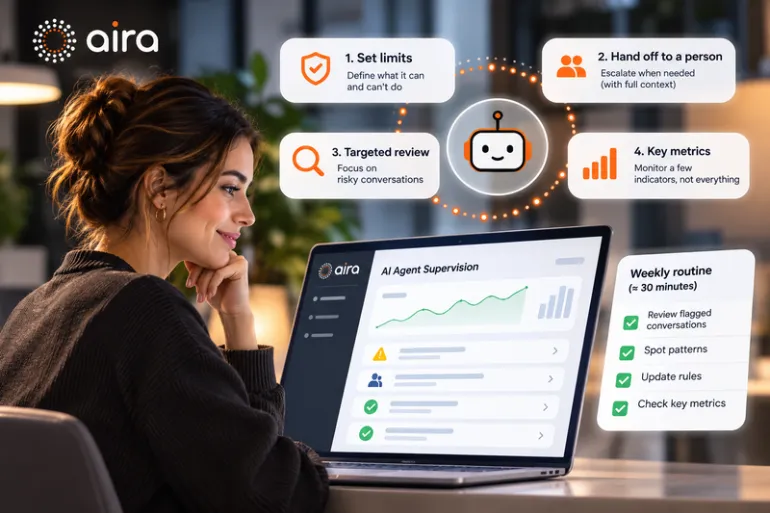
Recognizes when a question falls outside what it can resolve (a complaint, an unusual technical case, negotiating terms) and hands it to your team with the conversation's context already captured.
Doesn't replace human judgment where judgment is required — it frees your team to use it where it actually matters, instead of answering "how much does this cost?" for the fifteenth time.
The goal isn't for the AI to look infallible. It's for the window that's currently empty — nights, weekends, holidays — to have a useful, honest response instead, and for whatever genuinely needs a person to actually reach one.
What Closing This Gap Costs
Setting up Aira Web runs $1,499 (includes the first month), then a flat $385/month after that — no surprises, no scaling fees based on conversation volume.
Compare that to the number you ran above: if your after-hours gap is conservatively costing you several thousand dollars a month in opportunities that never convert, a flat, predictable monthly fee stops being a tech expense and becomes the difference between capturing that demand or continuing to let it walk.
Objections Before You Commit
"What if the AI answers wrong and it looks worse than not responding at all?" That's why Aira Web is set up with your business's actual information, not generic AI responses trained on whatever's out there online — and why it hands off to your team the moment a question falls outside that known territory.
"I already have a contact form, why do I need this?" A form collects data so you can respond later. Aira Web responds in the moment — which is exactly the window where you're losing most of those people today.
"I'm not sure this works for my specific industry." Fair question, and the honest answer depends on your customers. The agent works from your own services, prices, hours and FAQs, so it fits any business where visitors ask repeatable questions outside opening hours. The quickest way to find out is to test it against the questions your own visitors actually ask.
"I don't have time to set this up or maintain it." Setup is managed by Aira — it's not a self-serve tool you have to build and maintain yourself. You provide your business information once; upkeep is on us.
Written by the Aira content team, specialists in conversational AI agents for ecommerce and service businesses.
Frequently asked questions
Does an AI agent like Aira Web replace my customer service team?
No. It answers after hours and during spikes of simple, repetitive questions; when a question needs human judgment, it hands off to your team with the context already captured.
Does the AI make up prices or information it wasn't given?
It shouldn't, and that's the standard any agent like this should be judged on: Aira Web answers using the real information you configure about your business, not generic responses.
What happens to questions the AI can't resolve?
They're handed off to your human team with the conversation history, so you're not starting from scratch.
Does this work for any type of service business?
It works best when there's real, recurring commercial inquiry volume and the capacity to handle the leads it captures — if your site barely gets traffic or inquiries yet, the first move isn't an AI agent, it's generating that demand.