How to Supervise and Control Your AI Agent's Responses Without Wasting Time
Control what your AI agent says without reading every chat. A 4-layer method and 30-minute weekly routine for small business owners and ops teams.
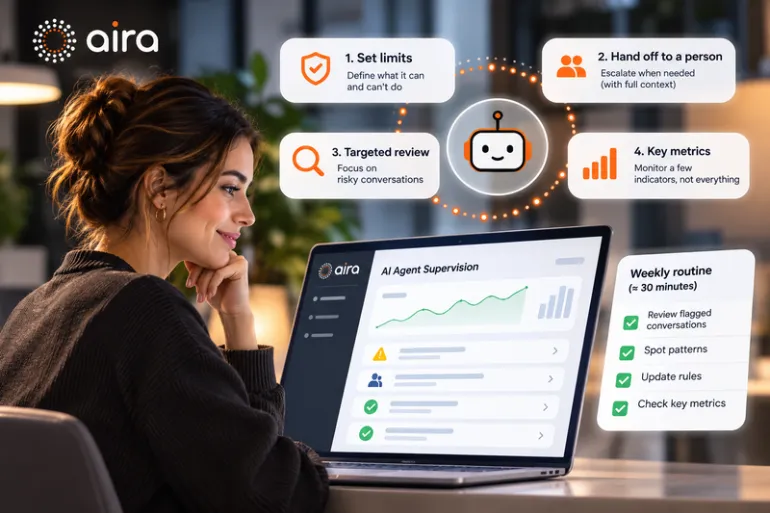
The short answer: you don't need to read every conversation. Supervising an AI agent well comes down to four layers: limits before it answers, rules for handing off to a person, targeted review, and a few alert metrics. With that, a small business can stay in control with about 30 minutes a week .
If you're the person who gets called when the AI gets something wrong, you've probably thought it already: "If I have to check everything it says, I'm not saving any time." You're right about one thing and wrong about another. You're right that reviewing everything cancels the benefit. You're wrong that the only alternative is blind trust.
There's a middle path called supervision by exception: the AI works on its own, and you step in only when something warrants it. The rest of this article shows you how to decide what warrants it.
What's inside
Why "review everything" fails (and so does blind trust)
Layer 1: set limits before the AI answers
Layer 2: rules for handing off to a person
Layer 3: targeted review, not random sampling
Layer 4: three metrics and the silent failure
The 30-minute weekly routine
When you're over-supervising
FAQ
1. Why "Review Everything" Fails (and So Does Blind Trust)
Two models of human oversight dominate the conversation about AI agents. With human-in-the-loop, a person reviews or approves each response or action. With human-on-the-loop, the AI operates autonomously while people monitor it and step in when an anomaly or policy violation appears, as described by Cobbai.
For most small businesses, the answer that works is a mix scaled to risk: heavy oversight where money, data or legal commitments are involved, and light oversight for questions like "What time do you open?" Cleanlab makes the same argument: the intensity of oversight should match what's at stake.
There's a trap on the other side, too. Over-supervising has a cost. If every reply passes through a person, you lose the very advantages that justified automating in the first place.
The key idea: the goal isn't to see every conversation. It's to see the few that matter.
But how do you know which ones matter before you read them? The four layers answer that, starting with the one you set up before the AI says a single word.
2. Layer 1: Set Limits Before the AI Answers
The best supervision prevents the mistake instead of catching it afterward. Three decisions get made once:
Where it can pull information from. An agent that answers only from your company's real information (services, prices, policies, catalog) invents less than one that improvises from general knowledge. That's the design principle behind Aira: answers grounded in real company data.
What it can't talk about. Legal or medical advice, promised outcomes, unauthorized discounts, other customers' data.
Which actions need approval. Reading a record is low risk. Issuing a refund, canceling a service or setting contract terms is high risk and needs a human approval gate. The Pedowitz Group recommends exactly this kind of sign-off for sensitive steps.
These limits are called guardrails (automated rules). They don't replace human review. Production systems use both.
3. Layer 2: Rules for Handing Off to a Person
A good handoff doesn't depend on someone watching. It's defined by rules:
By topic: billing, complaints, cancellations, anything legal.
By uncertainty: if the AI doesn't have the information, it should say so and pass the conversation along instead of making something up.
By request: if the customer asks for a human, they get one, no debate.
By value: high-budget inquiries or key accounts.
And the part many teams forget: the handoff must carry the context. If the customer has to repeat their problem, a recoverable conversation turns into a complaint. Enterpret's agent quality review framework flags this as a core check.
4. Layer 3: Targeted Review, Not Random Sampling
The most common mistake is reviewing "a few random conversations." The math is unforgiving: if your AI is wrong 2% of the time and you review 50 random responses a week, you should expect to find about one error, as Robylon points out. That's very little signal for the time spent.
Review by risk instead:
What to review | Why |
|---|---|
Conversations handed off to a human | They show where the AI didn't know the answer |
Conversations mentioning prices, timelines, warranties or legal terms | A mistake here has a real cost |
Conversations with negative sentiment or abandoned mid-way | Signal of a problem |
The first conversations after you change information, pricing or catalog | They catch regressions |
A small random sample (5–10) | A quality baseline |
This setup (a random baseline monitor, risk monitors and temporary monitors after changes) matches the approach described in Fin's guide to AI agent quality.
To score each conversation quickly, use a 5-question rubric (yes/no):
Did it give correct, current information?
Did it stay within what it's allowed to say?
Did it resolve the issue or hand off correctly?
Was the tone appropriate?
Was there data capture or a clear next step? (leads / cart)
5. Layer 4: Three Metrics and the Silent Failure
You don't need a 30-metric dashboard. Three alerts are enough:
Handoff rate: what percentage goes to a human, and why. A sudden shift means something changed: the AI doesn't know something new, or it became too cautious.
Correction rate: how often your team had to fix something the AI said.
Policy violations: times it said something on your off-limits list.
Compare each one against your own baseline, not against vendor "benchmarks."
The Silent Failure: What Almost Nobody Tracks
I promised a type of failure that rarely shows up in reports. Here it is: the conversation that ends with no resolution and no handoff. The customer just leaves. No complaint, no ticket, no alarm.
Enterpret's review framework calls these conversations that end with "no resolution and no escalation." For a service business, each one is a lost lead. For a Shopify store, it's a sale that evaporated. If you can only watch one more thing, make it this.
6. The 30-Minute Weekly Routine
Here's the whole system as a calendar:
When | What to do | Time |
|---|---|---|
Monday | Check the 3 metrics and the handed-off conversations | 10 min |
Wednesday | Review 8–10 risky conversations with the rubric | 15 min |
Friday | Turn each error into an action: fix the information, add a limit or add a handoff rule | 5 min |
The rule that closes the loop: every error becomes a rule or a corrected piece of data. Turning individual failures into tests and new guardrails is what makes the system improve, per the Pedowitz Group. If the same mistake shows up twice, supervision failed at Layer 1.
30-second self-check: could you say right now, without looking, how many conversations last week ended unresolved and without a handoff? If the answer is "no," you know where to start.
7. When You're Over-Supervising
Signs that supervision is costing you more than the errors it prevents:
You review every response "just in case."
You put an approval gate on low-risk actions.
You haven't changed a single rule in months (you're not learning anything).
Your team spends more time checking the AI than they used to spend answering.
Too much review erases the benefit of automation, just as too little lets inappropriate responses reach unhappy customers. The fix is to ease off on what hasn't failed in weeks and concentrate on what changes: a new catalog, new prices, new services.
Closing
At the start, I told you there was one kind of failure almost nobody watches: the conversation that fades out on its own, unresolved and with no handoff. Now you know how to find it, and that it takes 30 minutes a week, not a quality department.
Supervising well isn't distrusting the AI. It's designing it so that when it does get something wrong, the mistake is small, visible and cheap to fix.
Frequently asked questions
How much time does it take to supervise an AI agent?
It depends on risk and volume. As a starting point, about 30 minutes a week with the routine above. Plan for more in the first two weeks and after every change to your information.
Do I have to read every conversation?
No. Reviewing everything cancels the savings. Review handed-off conversations, risky ones (pricing, timelines, legal topics), those with negative sentiment, and a small random sample.
What does the AI do when it doesn't know the answer?
It should say it doesn't have that information and hand off to a person with the conversation context. It should never make something up. Test this before you go live.
Can an AI agent make mistakes?
Yes. No agent is infallible. That's why limits, handoffs and review exist. Anyone promising "zero errors" is selling smoke.
Which actions should a person always approve?
Refunds, cancellations, contract terms, and any financial or legal commitment.
How do I know if the agent is losing customers without my noticing?
Look for conversations that end with no resolution and no handoff. They're the silent failure: no complaint, but often a lost opportunity.